Exhibition: In Other Worlds by Liam Young at Barbican Centre London
/The imagination, inventiveness and information displayed in this exhibition left us feeling incredibly uplifted. A restored faith in our fellow humankind! Something that is hard to achieve when discussing the liveable future of Planet Earth. There is a lot of doom and gloom to overcome.
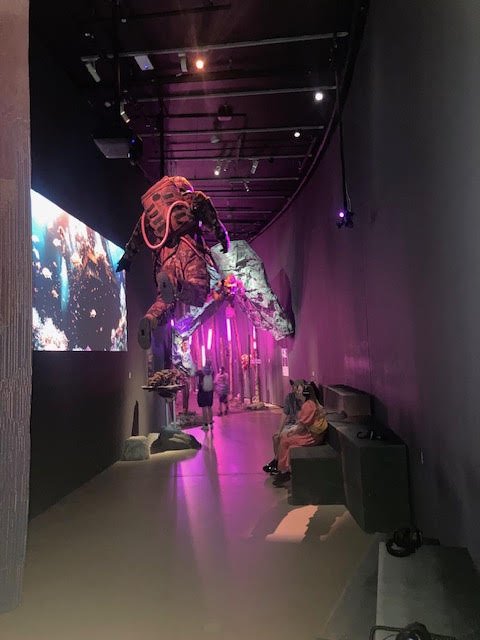
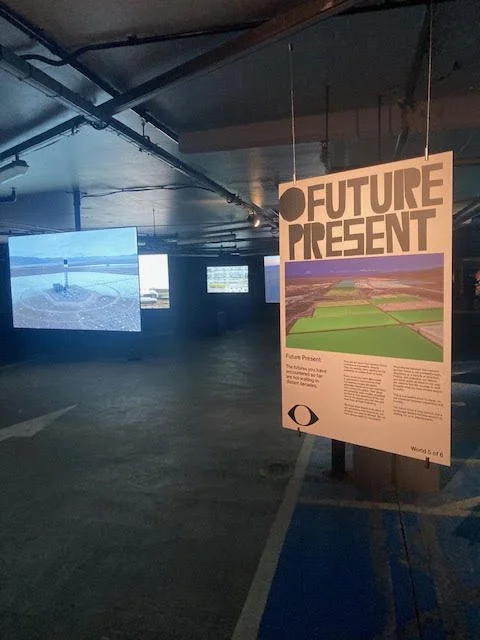
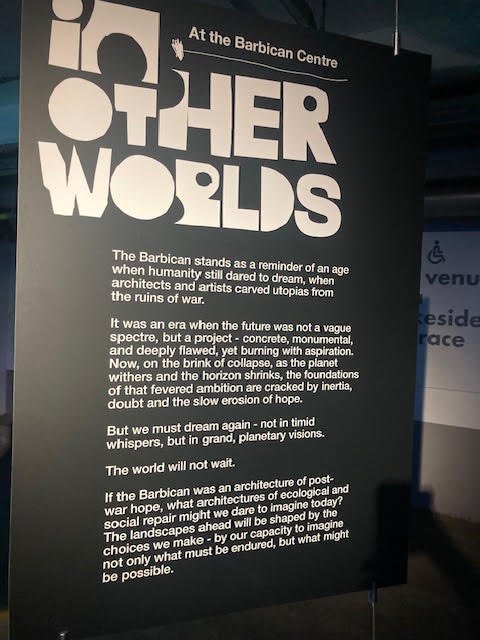
The exhibition is displayed in the excellent Curve area of The Barbican Centre. It’s incredibly immersive from the get go. The exhibition invites us to be a part of the future. To explore the possibilities and challenges we face. It’s on until 6th September 2026 - if you can travel up to London to see it we highly recommend!
If you’re not able to make it, here’s some info from the exhibition we wanted to share!
You walk through 4 possible futures. Each is brought to life through creative sets with models, films and graphic novels. Hearing from storytellers, scientists and others along the way who share their tales of fear and wonder.
There is World Machine - focused around excavating materials and rebuilding our future from our current world in a regenerative, non-destructive way. ‘To dream of Artificial Intelligence at a planetary scale is to reimagine the Earth itself becoming a machine. Valleys as circuits, salt flats become processors, and rivers as flows of power and calculation. But can we reshape our world without repeating the destruction of the last age?…The metal of the fossil age is melted down and returned to the ground it came from. Not as waste, but as new materials to be quarried from mountains of discarded machines….What is taken from the Earth is finally designed to return to it, rewilding our planet to restore balance. Destruction is our responsibility and dismantling our ceremony. Perhaps technology offers us the chance to remake the ground beneath our feet.’
After The End is next - a world of return, recreation, repair and upcycling. ‘The vast infrastructure of extraction - oil rigs that rose like steel beasts from the sea, gas plants sprawling across ancestral plains- are no longer monuments to empire….The end of fossil fuel becomes a beginning, of futures written not in smoke, but in stars. After the end, new worlds take shape from what remains.’ Within the exhibition you see a movie miniature model of a new island fishing community formed atop the submerged remains of a sunken oil rig. Transformed into an artificial reef. ‘It is a story of mending fishing nets and tending to the reef, of ancestral satellite launches, and the ceremonial deconstruction of a dead industry.’
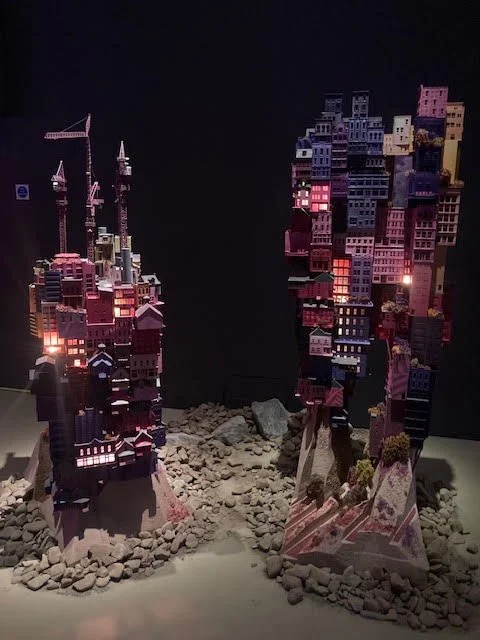
Planet City was a favourite- an imagining of one giant city. ‘One city with seven thousand languages. Ninety million songs looping through the streets in an endless procession of celebrations. A city alive with culture, stacked in layers like geological strata. Beyond its edges, forests reclaim the horizon. Rivers wander unchannelled. The 142 million square kilometres outside of the city become a protected park, to roam and explore. Where we make room for species and the return of stolen ground. The earth breathes again. To gather together is to give back. To live closer is to make space. In this world, our greatest construction is the land we choose not to build on.’
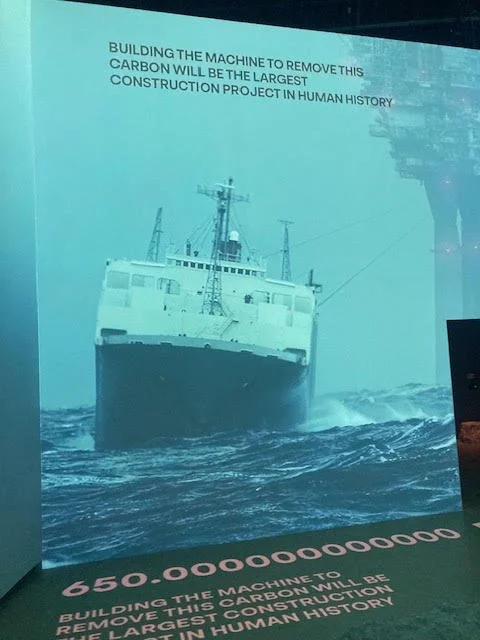
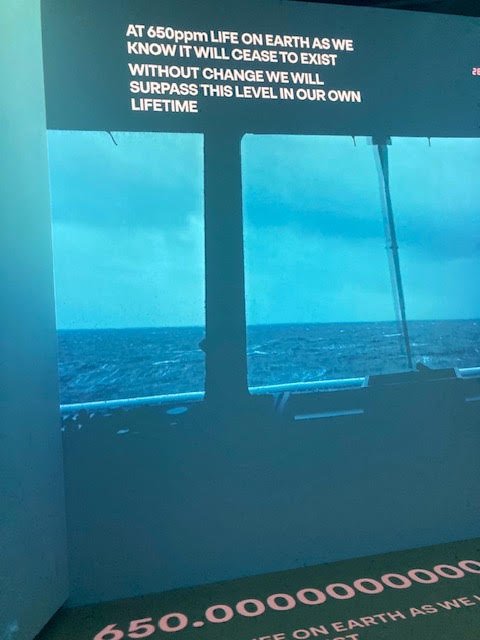
The last future world to explore was set in one large room, each wall and ceiling projected on to with films exploring The Great Endeavor. A massive project of restoration. ‘Across continents, a new infrastructure rises, not of extraction, but of return. Fields of wind turbines turn. Deserts glisten with mirrors. Fans draw air across vast filters, transforming carbon from burden to substance. It is liquified, then mineralised and sky becomes earth. Below the waves, carbon is bound into the ocean floor, and from beneath the dunes, new mountains rise. A new ground forms, dense with our collective breath. These machines do not replace forests. They stand beside them, to accelerate the long work of recovery…a planetary collaboration, an act of repair as vast as the damage.’
The next part of the exhibition is where these imagined futures become real as you learn about the technologies that already exist. That each of the possible futures explored are grounded in real science. ‘One film brings together leading voices in the future of food production, exploring vertical farming, algae cultivation, and autonomous agricultural systems. Another documents interviews with pioneers in active carbon removal and storage…where geothermal energy powers machines that draw carbon directly from the air and return it to stone. Aerial drone footage traces vast planetary infrastructures, thermal solar fields…Americas largest wind farm…and the worlds largest and most sophisticated high altitude astronomical observatories in Chile. These sites stand as prototypes for the scale of global collaboration required to confront the climate crisis, evidence that the future is already under construction.’
The exhibition ends with these uplifting words:
‘We arrive here knowing something as shifted.
Not because the world has suddenly become simpler, but because it has becomme visible.
The machines we have seen today are no longer science fiction.
They already exist - in mines and factories, in test sites and deserts, on coastlines and beneath oceans.
What once looked like a dream now turns quietly in the background of the present.
This is no longer a crisis of technology. The tools and knowledge are here, what remains unresolved is imagination.
The limits we face are not physical; they are limits of habit, fear, of politics and prejudice.
At this scale, imagination is not decoration. It is infrastructure.
We are already living inside a planetary experiment.
The atmosphere is altered, the oceans are warming, and the rocks will remember us. But stories allow us to rehearse what cannot yet be built.
They let us test our ethics before we test our atmosphere, giving shape to futures before they harden to fact.
To imagine boldly now is not an indulgence; it is a responsibility.
We must dare to do impossible things, to build a mythology of immense undertaking and reimagined grounds.
Here, we learn to grapple with the terrible beauty of our own making, The worlds we have just walked through are not solutions, They are provocations, rehearsals, and invitations to think differently about what might come next.
The futures we imagine do not remain imaginary for long; they settle into policy, they harden into concrete, and they sink into the fossil record.
If there is hope to be found here, it is not in certainty, but in courage.
On the brink of extinction, with the ground shifting beneath us - this is where we become our most extraordinary.’
Information from:
In Other Worlds - Liam Young - Barbican Centre, London - until 6th Sep 2026.